William Aloysius Brady
American Theatre Actor, Producer, and Sports Promoter
b. June 19, 1863 - d. January
6, 1950
|
|
|
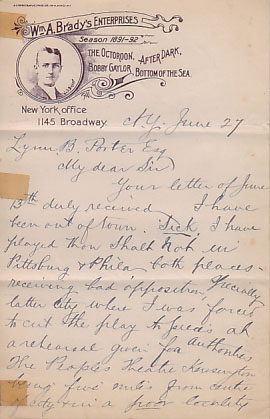
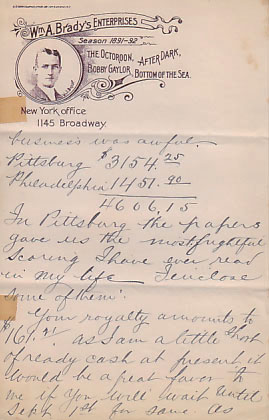
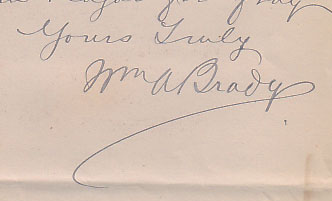
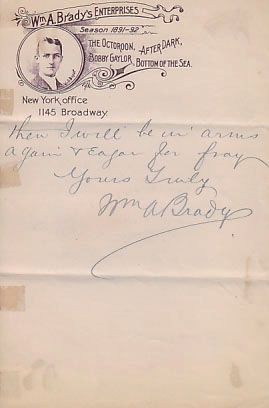
Boxing promoter/manager William A. Brady has boldly written and signed this three page ALS in black fountain pen ink... Penned on beautifully illustrated Wm. A. Brady's Enterprises stationary during his 1891-1892 theatrical season... A rare signature from boxing's first to manage two undisputed world heavyweight champions, James J. Corbett & Jim Jeffries!!
click here for enlarged view
measures: 5.5 x 8.5" (each page)
condition: discolored tape staining at left of each page,
some glue staining on reverse of last page, usual
fold creases from being mailed
$250
$12 insured shipping
|
N.Y. June 27 Lynn B. Porter Esq. My Dear Sir Your letter of June 13th duly received. I have been out of town. Sick. I have played Thou Shalt Not in Pittsburg & Phila. both places receiving bad opposition, specially latter city where I was forced to cut the play to pieces at a rehearsal given for authorities. The Peoples Theatre Kensington being five miles from centre of city & in a poor locality |
business was awful. Pittsburg $3145.25 Philadelphia 1451.90 4605.15 In Pittsburg the papers gave us the most frightful scaring I have ever read in my life. I enclose some of them. Your royalty amounts to $161.21 as I am a little short of ready cash at present it would be a great favor to me if you will wait until Sept. 1st for same as |
|
 |
 |
|
Brady was born to a
newspaperman in 1863. His father kidnapped him from San
Francisco and brought William to New York City, where his father
worked as a writer while William was forced to sell newspapers
on street corners. Upon his father's death when William was 15,
he
hitchhiked
his way back to San Francisco. He made his start on the stage in San Francisco, California shortly after his return. As a callboy in The White Slave, he filled in a role for an ill actor, and started his career. After a failed attempt to produce a version of She by H. Rider Haggard, he was able to secure the rights to After Dark, successfully bringing the play to New York. While Brady was sued for his efforts, as Augustin Daly claimed plagiarism, Brady was able to make enough money to continue with his theater ventures. Brady inadvertently became a boxing promoter during this time. He cast James J. Jeffries in After Dark, and later introduced the man into the boxing circuit, where Jeffries would eventually become the undisputed heavyweight champion. Brady would be inducted into the International Boxing Hall of Fame in 1998, remaining the only person to manage two undisputed heavyweight champions, in Jeffries and James J. Corbett. Brady ran a successful theatre operation for thirty years, having met actresses like Grace George (whom he later married) and having, at one point, hired famous humorist Robert Benchley to complete ad copy for him. Brady's success continued until the Stock Market Crash of 1929, which wiped out his entire savings. He was able to secure the funds to produce Street Scene, which was written by Elmer Rice, won the Pulitzer Prize, and netted Brady a half a million dollars. His total theatrical output included over 260 plays, including a version of Uncle Tom's Cabin that was later used as images for a book in 1904, and a number of movies before his death in 1950. William Brady is interred at Sleepy Hollow Cemetery in Sleepy Hollow, NY. |