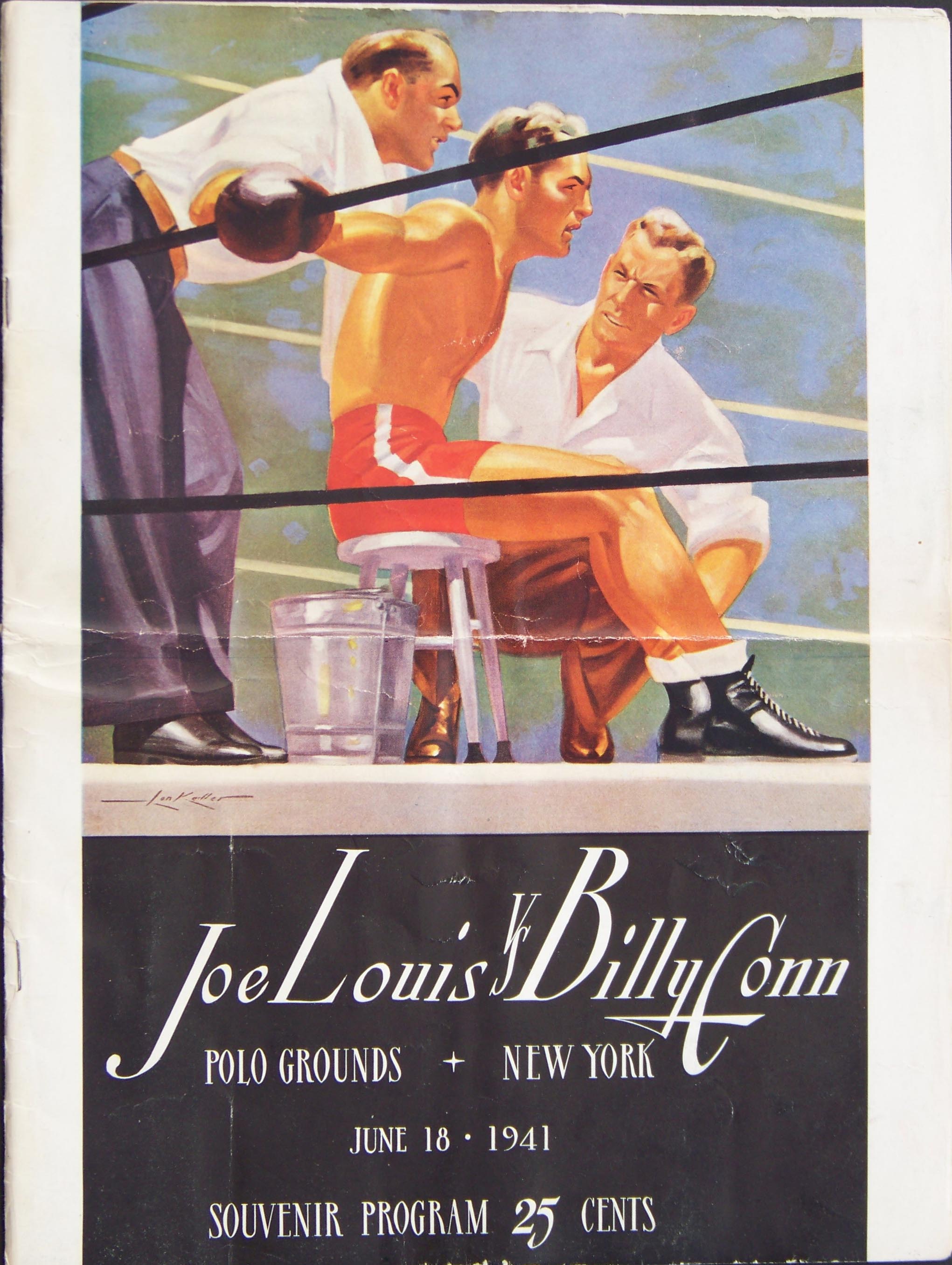
It was a scenario that had been repeated
many times before, a good little man versus a good big man:
Corbett versus Sullivan, Dempsey versus Willard, and the
classic, David versus Goliath. Now it was to be Billy Conn,
the former light heavyweight champion who had given up his
lighter crown to take on the heavyweight champion of the
world,
Joe Louis.
The fight was to be Conn's 174 ½ pounds vs. Louis' 199 --
their announced weight, although their actual weight was
really 169 and 204 -- boxer versus puncher, machine gun versus
howitzer.Many believed that it
was not merely a case of the dog in the fight, but the fight
in the dog. They conceded that Conn had a chance, a greater
one than any challenger since Max Schmeling, and made him the
shortest-priced underdog against Louis in three years, an 18-5
dog.
Conn had all the credentials to make
this a fight, more so than any of Louis' previous 17
challengers, most of whom charitably fit into the disparaging
class known as "Bums of the Month." Billy the kid had gone
into battle 67 times before, winning 58 and losing only eight,
all by decision. And although he had only twelve KO's to his
credit, six of those had come in his last eight outings
against the bigger boys -- men like Bob Pastor and Gus Dorazio,
both of whom were past victims of Louis.
Conn's adherents also pointed out
that Louis was no longer the murderous puncher of a few years
before when he had destroyed Max Schmeling in 124 seconds. His
last three opponents -- Buddy Baer, Tony Musto, and Abe Simon
-- had gone an average of almost 10 rounds. Louis' age, 27,
and his recent susceptibility to injury -- he was cut under
the left eye in his most recent fight, which took place just
three weeks before, against Baer -- gave further proof of his
"slippage." Or so it was argued.
Conn's consummate boxing skill, with
his flashy left hand serving as the centerpiece, made him a
lineal descendant of Jim Corbett, the first of the great
scientific boxers. Further, Conn could block his opponents'
punches by "rolling" with them. It was argued that even when
hit Conn had remarkable recuperative powers, having been
knocked down only twice in his career, once by Oscar Rankins
and once by Solly Krieger, and gotten up to finish both
fights, beating Rankins in the process. Sweet William had
always used his ring craftsmanship and speed to defuse his
opponent's power, something his followers thought he could
easily do against the slower-moving Louis.
If there was any rap against Conn, it
was that he was headstrong, often trading punches when stung
rather than moving away. Against the powerful Louis, this was
seen as Conn's potential Achilles' Heel. However, he was
determined not to let that happen in this, his big chance.
"I know I have lost my temper in some
fights," the strong-willed Irish challenger said before the
fight, "but you can't bet I won't this time." And bet his fans
did, bringing the last-minute odds down to 11-5, Louis.
Many in the crowd of 54,487 who
jammed into the Polo Grounds that Wednesday night, June 18,
1941, believed Conn could do it. Members of the press,
including Hype Igoe and Willard Mullin, had gone out on a limb
for Conn. So had several members of the boxing fraternity,
including champions James J. Braddock, Fred Apostoli, Gus
Lesnevich, Lew Jenkins, and Fritzie Zivic.
Of course Zivic could be excused for
his favoritism; he was a "homer" rooting for a fellow
Pittsburgher. But he was just one of more than 6,000 fight
fans who had journeyed from the Steel City hoping that Conn
could catch lightning in a bottle and do something that four
previous light heavyweight champions had failed to do, win the
heavyweight championship.
But most of those in attendance just
wanted to see the much ballyhooed fight. One of those was Pete
Herman, the former bantamweight champion. Now blind, Herman
had come all the way from New Orleans to "see" the action.
Herman, like the other 54, 486 fans in attendance, hoped the
Louis-Conn to-do would match the excitement of the last title
bout held at the Polo Grounds, the Jack Dempsey-Luis Firpo
classic. Neither group, boxing's faithful nor Billy's fans,
would be disappointed.
After two rounds both the Conn
faithful and the boxing fans were wondering if Billy's
build-up wasn't merely that, a build-up, as Louis pursued Conn
across the ring, landing some heavy punches without more than
a few token returns. From the opening bell, when Louis
advanced immediately over to Conn's corner to "get at" the
challenger, through the next six minutes of fighting, it was
all Louis as he kept up a steady tattoo on Conn's body,
staggering him with two rights in second, and controlling the
action Conn made a great effort to evade the oncoming Louis
and stay continually on the move. But that was all.
The third round was different.
Although retreating, Conn was able to connect several times
with his left, even stopping to hook his left into Louis' face
and follow up with a left-right that forced Louis to hold on,
something he hadn't had to do in his previous 17 defenses.
Conn's sudden success gave heart to his adherents and credence
to the rumor that Conn was a slow starter because of an
unusually slow heartbeat which required a warm-up period.
Conn started Round 4 in
characteristic retreat and then suddenly stopped and threw a
straight left which connected with the oncoming right to the
jaw, buckling Louis' knees. On the attack for the first time,
Conn threw several short shots at Louis, most of which
connected. Then Conn landed a hard left to the head and a
right to the jaw. This was the Conn everyone had been
promised. It also was the fight they had come to see.
Just as the momentum had swung to
Conn, however, it swung back again to Louis. The champion hurt
Bill with a left to the stomach, then, in close quarters,
landed a vicious left hook to the jaw which staggered the
challenger, who fell in against Louis. Louis followed up with
a torrent of punches to the unprotected flanks of the
challenger who, at the bell, staggered to the wrong corner.
Revived by smelling slats, Conn
resumed his dancing in Round 6. But Louis, moving in on his
target, dragging his back foot as if he were wiping it off a
door mat, found his elusive target and pounded his body,
buckling the challenge's knees with a vicious left hook to the
pit of the stomach. Miraculously, Conn came back to score with
a flurry to Louis' head, but Louis found Conn again to the
body and head, opening a small cut over Billy's right eye.
Conn continued his dancing in Round
7, staying out of Louis' reach and even landing a few flurries
of his own for good measure. Round 8 found Conn moving in for
the first time since the fourth, jarring Louis with repeated
one-twos, once when pinned against the ropes. The round ended
with Conn swarming all over a suddenly bewildered Louis,
rattling rights and lefts to the vulnerable head of the
champion.
Brimming with confidence, the
suddenly laughing challenger moved in on Louis, telling him as
he pulled the champion into a clinch, "You've got a fight on
your hands, Joe." And Joe knew it as Conn punctuated his
remark by banging both hands to the head, following up with a
left to Louis' face and a right that landed squarely on Louis'
jaw, which hung open in amazement and pain. Shuffling forward,
a newly-frustrated Louis resorted to pushing Conn into the
ropes and throwing one right as the quicker challenger
retaliated with a right and a left to the head and a right to
the body. Suddenly the fight was all Conn.
Unable to land any effective blows to
Conn's continually bobbing head, Louis followed Sam Langford's
old adage to "kill the body and the head will follow," digging
a left and right into Conn's stomach and then following with
another left which he sunk into the pit of the challenger's
midsection and a left to the head. All of a sudden the
challenger was on the floor. But referee Eddie Joseph ruled it
a slip, the second slip by Conn. And Louis, ever the
sportsman, stepped back and allowed his momentarily
defenseless foe to regain his footing.
Conn came back in the 11th, dashing
out of difficulty whenever the steadily advancing champion
forced him into the ropes. He also tied up Louis or held on
whenever "The Brown Bomber" attempted to force the action.
Then the handsome Irishman would launch his own attack to the
head, forcing Louis to hold on to avoid Conn's seemingly
endless stream of punches.
The 12th was a revelation as Conn
danced less and punched more, connecting time and again with
rights and lefts to the head of Louis. Then, toward the end of
the round, Conn staggered Louis with a left hook to the jaw.
The hunter had now become the hunted. Conn pursued Louis who
was clinging on for dear life. The man who had Primo Carnera
cowering, Max Baer frozen with fear, and Max Schmeling
screaming in pain was in desperate trouble for the first time
since his loss to Schmeling five years earlier. At the bell
the crowd was on its collective feet, cheering frantically,
assured now that they were witnessing the sequel to Dempsey-Firpo.
With the reviving smell of ammonia
stinging his nostrils and the ringing words of his trainer,
Jack Blackburn -- that Louis "had to knock him out to win" --
stinging his ears, Louis came out of his corner for the
thirteenth hell-bent upon finding his quarry and bringing him
to bay. Conn greeted the now purposeful champion with a right
and a left to get his attention, the right cutting Louis' ear.
As Conn waded in with a left to the stomach followed by a
right that missed Louis' chin, the champion landed a hard
right of his own. It caught Conn flush on the jaw, snapping
his head violently back. Louis followed with three more hard
rights to the chin, but, untrue to his preflight statement
that he would run away to stay another day, Conn fought back,
out slugging the champion at close quarters in a savage
exchange. A right uppercut by Louis staggered Conn. Louis, now
sensing the moment he had been waiting for the past 38
minutes, landed a volley of rights and lefts to Conn's head.
Another right to the head spun Conn part way around and he
fell as if he were filmed in slow motion. Referee Eddie Joseph
picked up the count over the inert form that had almost been
the heavyweight champion of the world.
Conn tried to regain his feet,
leaving his haunches at the count of 10, but it was a split
second too late. Referee Joseph signaled "the end" at 2:58 of
the 13th.
The fight itself was memorable. It
was magic, and it was one of the greatest ever seen in this or
any other era. Joe Louis, the man who had been just six
minutes and two seconds away from losing his crown to the man
he called "the slickest" he had ever faced, had come back to
reclaim and retain his title. And lay claim to his legacy as
the greatest heavyweight of all time.
As he left the ring Louis spied his
manager, John Roxborough, smoking a cigar. "How many of those
you swallow tonight?" asked "The Brown Bomber." He needn't
have bothered. Everyone who had seen the fight, Roxborough
included, had swallowed. And swallowed hard.